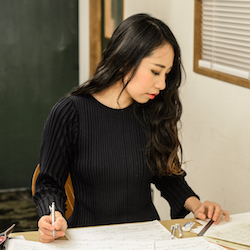


Yu KUWABARA
Yu Kuwabara (b. 1984) is a Tokyo-based Japanese composer whose work explores the relationship between sound, language, and the body. Her music is characterized by a subtle intensity, focusing on resonance and the perception of time rather than overt dramatic expression.
Drawing from long-term engagement with Japanese musical traditions and contemporary compositional practice, she creates works that connect cultural memory with present-day listening. Her output ranges from solo and chamber music to large-scale ensemble and orchestral works, while a significant part of her practice is devoted to compositions rooted in Japanese traditional performance contexts, including works for Shōmyō and Gagaku. Her music has been presented internationally by leading festivals, ensembles, and concert halls.
In 2024, her first portrait album YU KUWABARA: Sounded Voice, Voiced Sound was released by KAIROS. She is the recipient of the 31st Yasushi Akutagawa Suntory Award for Music Composition (formerly known as The Akutagawa Composition Award) and several international composition prizes. Her scores are published by Edition Gravis and Edition Wunn.
Kuwabara is currently Associate Professor at Kunitachi College of Music and the Graduate School of Kunitachi College of Music and a part-time lecturer at the Tokyo National University of Fine Arts and Music, Senzoku Gakuen College of Music, and the graduate school of Senzoku Gakuen. She is active as a composer, educator, and writer. She is also a founding member and composer of Awai-Za, an ensemble-unit exploring contemporary creation through Japanese Edo-period culture.
Position Statement
My work grows from an internal engagement with Japanese musical thought and culture, not from their external representation. I do not approach Japanese tradition as an object to be studied or quoted, but as a lived creative ground—one that continues to shape how sound, time, and the body relate to one another.
Central to my practice is the idea of sound as a phenomenon rather than an object: sound that becomes through resonance and temporal movement. Concepts such as gesture, becoming, and pre-linguistic experience are not theoretical themes added afterward, but elements that emerge directly from the act of composition itself.
My music seeks to create spaces where Japanese musical sensibilities—often rooted in oral transmission, bodily memory, and ritual time—can resonate within contemporary contexts without being reduced to stylistic markers or exotic references.
Through composition, writing, and teaching, I aim to articulate a perspective in which Japanese musical thought is neither preserved nor translated as a fixed heritage, but allowed to remain a living force that continues to generate new forms of listening and creation.
Selected Press
Traditions are never hermetic, nor are they necessarily limited to one cultural area – instead, they can be updated, transferred, superimposed… and that is called innovation.
— KonSequenzen, ACHT BRÜCKEN | Musik für Köln
Perhaps her most extraordinary piece is this hour-long work for a vocal consort of Buddhist monks.
— Bachtrack, Eight women composers to watch in 2023
In ihren Kompositionen bringt die junge Japanerin uralte Traditionen ihres Landes und zeitgenössische Ideen in Einklang.
— Die Komponistin Yu Kuwabara Neu und alt sind kein Widerspruch, Deutschlandfunk
Research & Composition Statement
My compositional research investigates how sound comes into being through bodily gesture, temporal perception, and pre-linguistic experience. Rather than separating theory and practice, I treat composition itself as a form of thinking, in which musical structure, notation, and performance function as sites of inquiry.
A significant part of my work is grounded in Japanese traditional musical practices, including Shōmyō, Gagaku, and other forms based on oral transmission and ritual time. These traditions are not used as references or stylistic materials, but as internal frameworks that inform my understanding of sound, voice, and duration.
Alongside these practices, I compose for contemporary ensembles and orchestral contexts, exploring how culturally specific modes of listening can coexist with and transform contemporary compositional languages.
My research is developed through scores, performances, lectures, and written texts, and is closely connected to my work as an educator. Through this integrated practice, I seek to enable dialogue between Japanese musical thought and international contemporary music without flattening their differences.
- バイオグラフィー|biography
- 桑原ゆうの作曲作品|Yu Kuwabara works
- これまでの活動|past performances
- ディスコグラフィー|discography
- メディア情報|press
- 作品発表スケジュール|future schedule
- 桑原ゆうオフィシャルブログ|Yu Kuwabara official blog
- コンタクト|contact us
- メールアドレス|mailaddress
- Yu Kuwabara's Twitter account @yupipipipipi
- Yu Kuwabara facebook
- Yu Kuwabara Instagram
- Yu Kuwabara YouTube account
- Yu Kuwabara SoundCloud
- home